Falling Fruit:
Creating an Urban Foraging Community
Duration: 6 weeks, Summer 2025
Impact: Created accessible community and interaction features for 1 million+ users based on research and feedback
© 2026 designed by Alice Lan

Usability Testing
Iteration
TESTING & ITERATATION
We conducted task-based usability testing with four participants to evaluate the effectiveness of our prototype. Each participant completed four core scenarios that reflected key user goals, allowing us to observe usability issues and measure task success. After the tasks, we gathered qualitative feedback on their overall experience to identify areas for improvement and refine our design.
Key findings and suggestions:
Some buttons and wording can be improved to be more intuitive
Add a drop-down navbar to get to the different sections of the community page
All participants found the tasks easy to complete and liked the overall formats of the pages
There should be an option to create local groupchats within the "Ask Your Community" forum
Due to the short turnaround between usability testing and our final presentation, we were only able to implement minor but meaningful improvements. These included fixing non-functional buttons, making the navigation bar sticky for easier access, and updating unclear wording based on tester feedback. While these changes improved usability, they were limited in scope.
Given more time, we would have iterated more extensively on layout, interaction patterns, and content structure. We also would have explored alternative formats for key features, conducted additional rounds of testing, and refined our prototype to better reflect user needs. Future iterations could focus on testing accessibility, onboarding flows for new users, and the effectiveness of community-building features. Despite the time constraints, our updates strengthened the core experience, and the foundation is in place for continued iteration.
Concluding Thoughts
THE END
Working on the Falling Fruit project came with its share of challenges and wins. One of the hardest parts was narrowing our scope. We had so many exciting ideas, but we had to focus on what was realistic and impactful. It wasn’t easy, but staying focused helped us create a prototype that addressed real user needs. A big highlight was seeing how our research directly shaped our design. The Reddit analysis and user survey gave us a clear picture of user frustrations, especially around communication and accessibility. That led us to build a community feature to help users connect and share knowledge.
This project taught me a lot about working under pressure, staying aligned with user needs, and letting go of ideas that don’t serve the bigger goal. If we had more time, I would have explored more innovative formats for the community space, tested with more users, and pushed the design further to emphasize local interaction and boosting engagement.
Our survey ended up being a huge asset, not just for us but for the Falling Fruit team. It gave them insight into what users want, including technical improvements beyond the scope of our prototype. While our design was just one piece of a large project, it created a strong foundation for deeper engagement and gave the Falling Fruit team a clear direction to keep building from.
Sketches
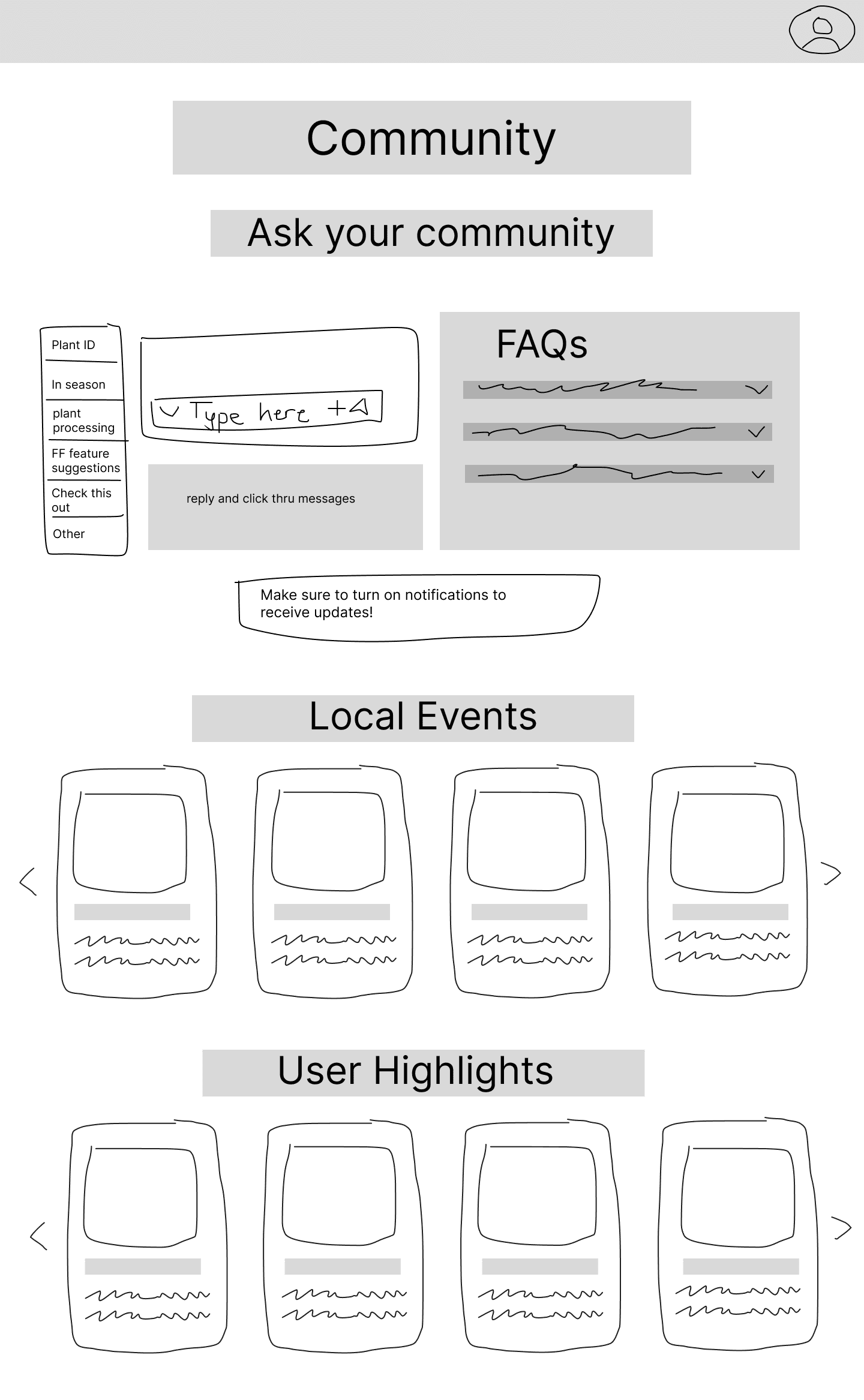
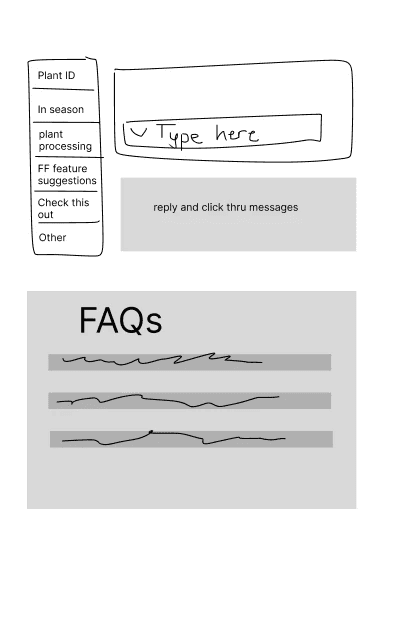
We did quick sketch lo-fi's to map out what we wanted our features to look like, the went straight to creating a midfi prototype so that we would have time to test it.
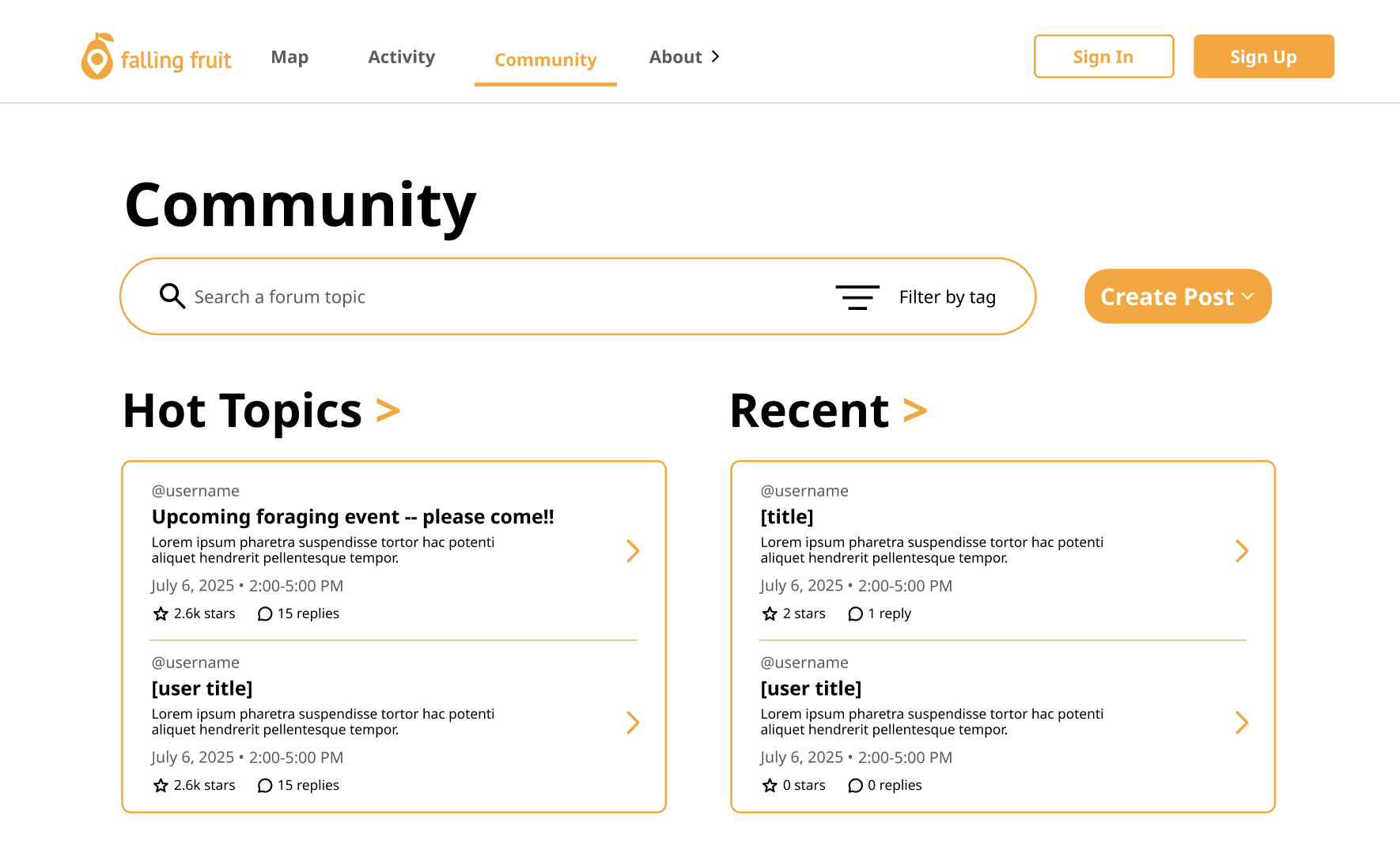
I was tasked with the the Ask Your Community forum/FAQ, which in concept is a page where people can get their questions answered, filter by location and topics, and the most popular questions go into a pinned "FAQ" category.
Later, this concept was simplified into a regular forum for the sake of keeping our final expo presentation within the 7 minute time constraints.
DESIGN
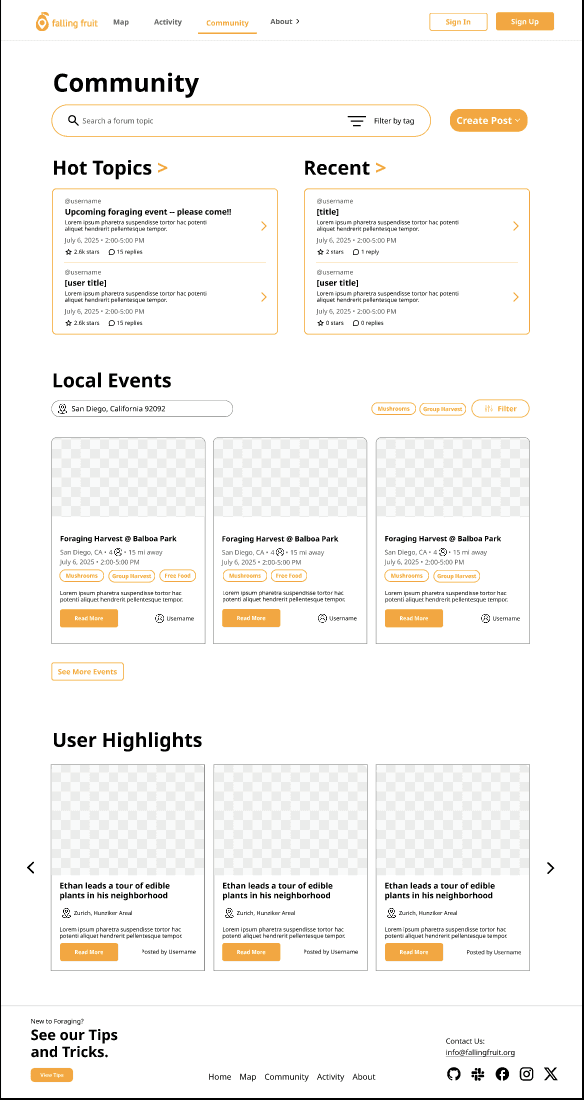
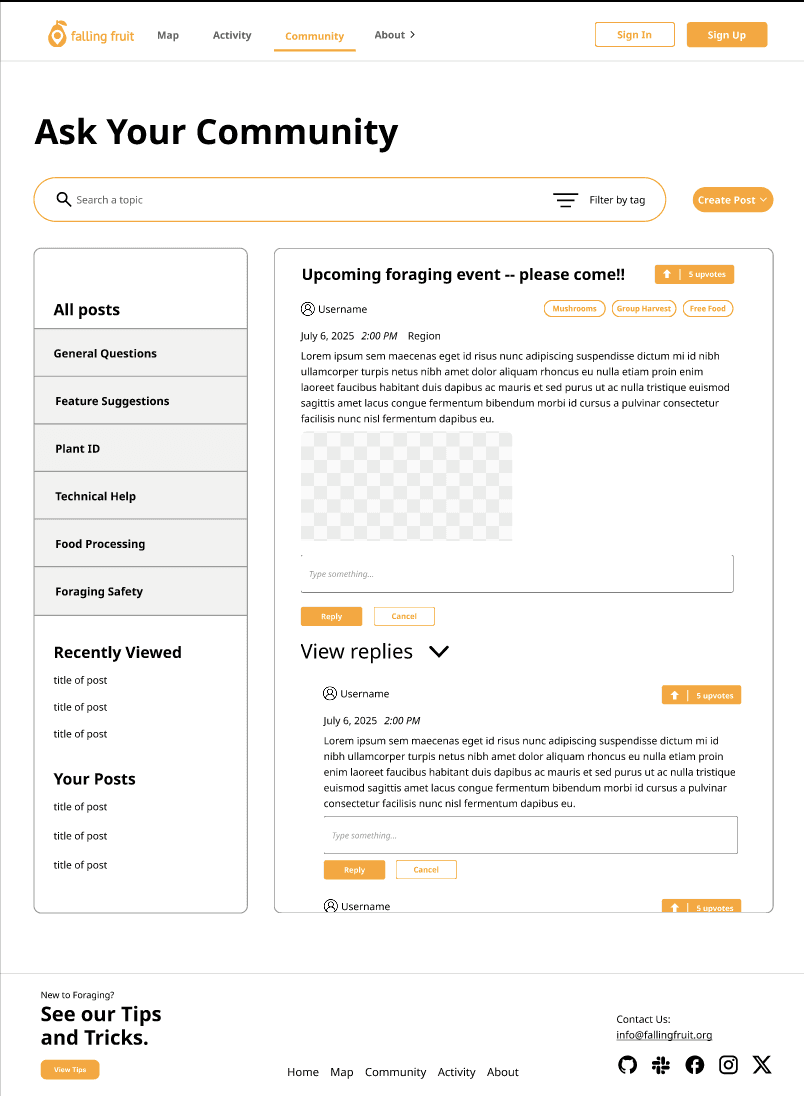
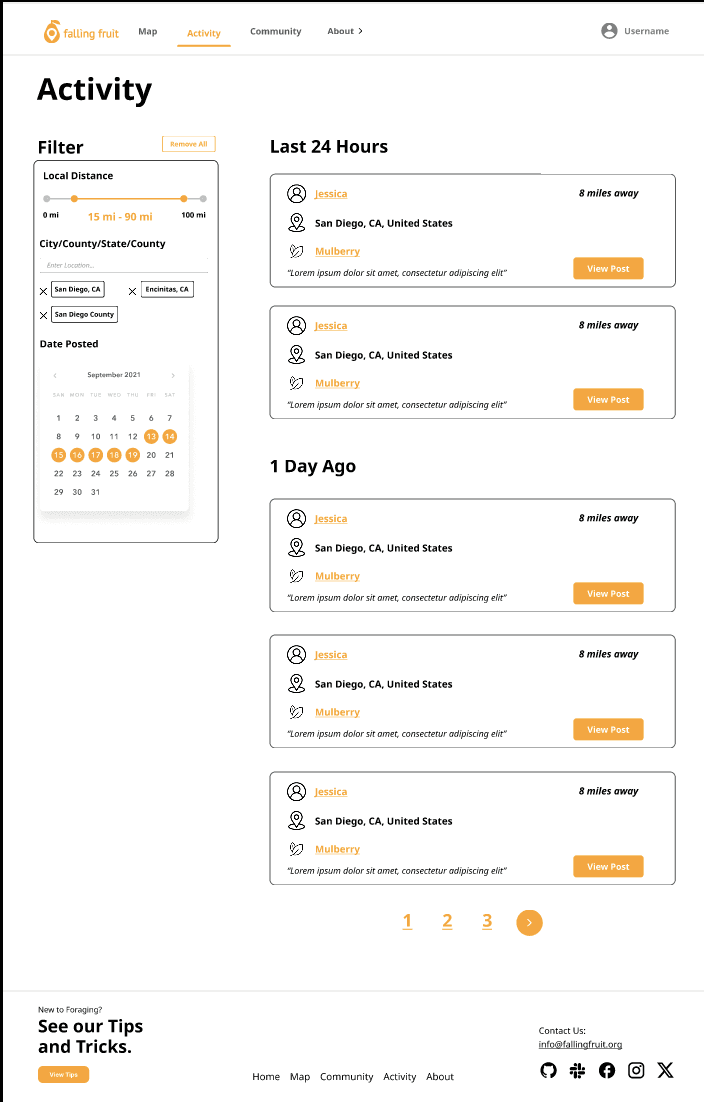
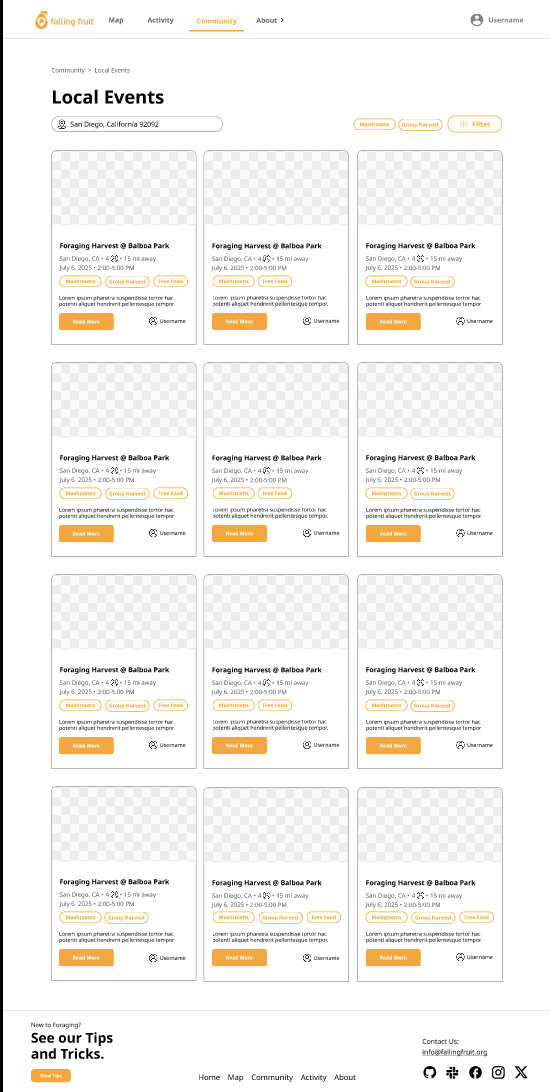
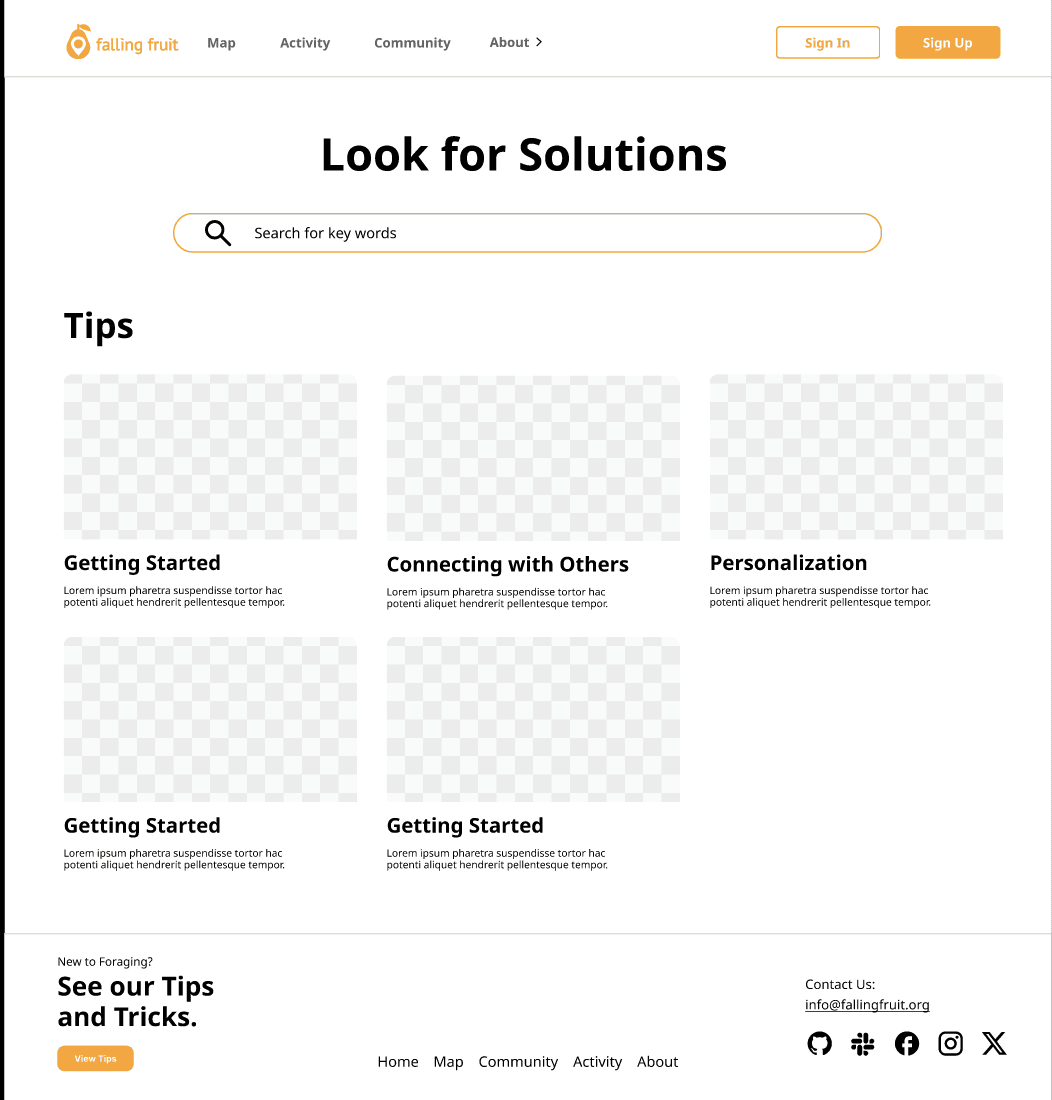
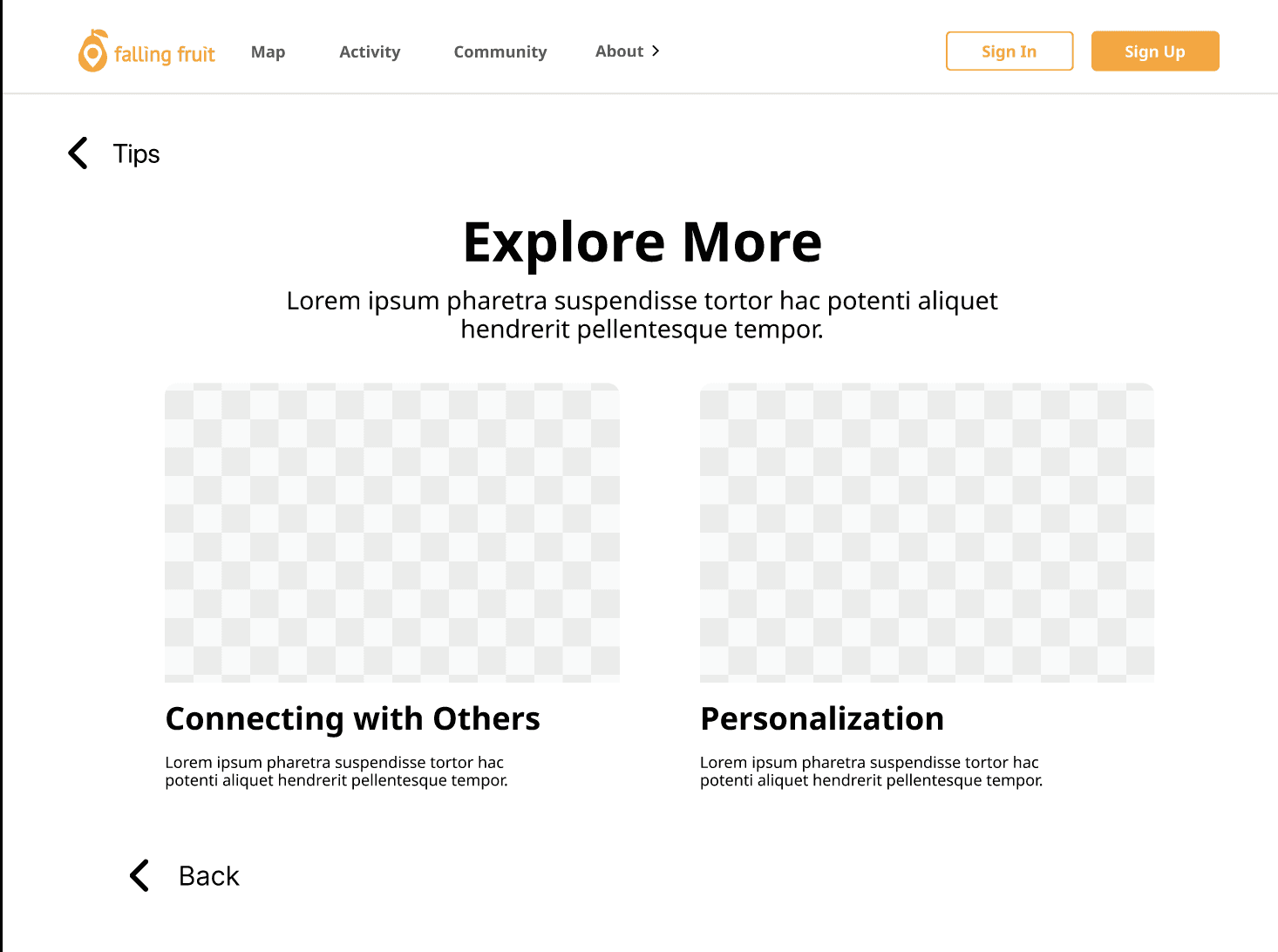
Midfi Prototype
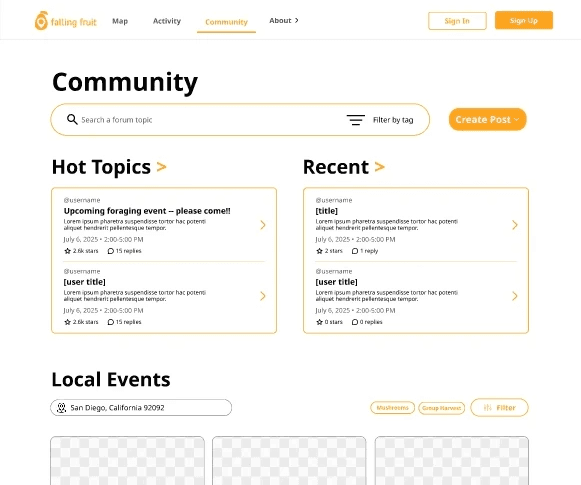
Our design system reflects that of Falling Fruit's new beta website. We chose to keep it simple with one accent color to fit the existing style of Falling Fruit's site. We wanted a main page with all the features accessible, as well as separate pages once expanded out. View the interactive prototype here.
In Short
My Role
Team: 1 project mentor, 4 UI/UX designers.
We collaborated with 12 other design teams and communicated with the Falling Fruit executive director + dev team at all stages.
Worked in a large-scale project to identify and solve Falling Fruit's user needs. This case study highlights the research, concept selection, and iteration process to reach our community solution.
UI/UX Researcher and Designer
Tools: Figma, Python
Discover
User Survey
SWOT analysis
Competitor Analysis
Affinity Mapping
Define
User stories
Concept Selection
Problem Statement
Ideation
Design
Wireframes
Prototypes
Test
Task-based Usability Testing
Deliver
Expo Presentation
One-Pager
Next Steps
This project had a very tight time constraint of 6 weeks. We dedicated four weeks to research and ideation, and two weeks to prototype and test. Working within this constraint meant our prototype and usability testing were not as fleshed out as is ideal, but we still managed to achieve the overall purpose and present a strong case for building community at the final expo.
Design Process
Falling Fruit is a collaborative map of the urban harvest around the world. It was created as a tool for urban foragers and currently boasts over 1 million users. Design for America brought together teams from universities across the US with the overall objective of identifying ways to improve the Falling Fruit user exeperience. Each team identified and tackled their own problem statement within this overarching task.
Context
Falling Fruit had many areas of improvement we could address. However, given the time constraint, we were unable to explore every problem in detail. After conducting some preliminary research, we saw a need to develop community between Falling Fruit users because it would enable people to connect, inspire, and educate each other in their foraging journeys. This would in turn drive more activity, engage users, and overall enhance the Falling Fruit user experience.
The Problem
DISCOVER

Competitor Analysis
iNaturalist is a platform similar to Falling Fruit, but at a much larger scale mapping every living species across the world. It also has very well-established community forums, support/help features, social network, and other ways for its user base to engage and collaborate with each other. We turned to iNaturalist as inspiration for potential concepts, but also recognized that the scope would be smaller and we would have to think about the realistic implementation of similar features on Falling Fruit.
Robin Greenfield is a similar website with a wide selection of foraging content and resources to get involved. It has a large subscriber base but low engagement across social media platforms. The visual communication appears overwhelming and can benefit from navigation, but there are opportunities for engagement (donate/shop/events) and direct methods for inquiries and help (an FAQ and contact page).

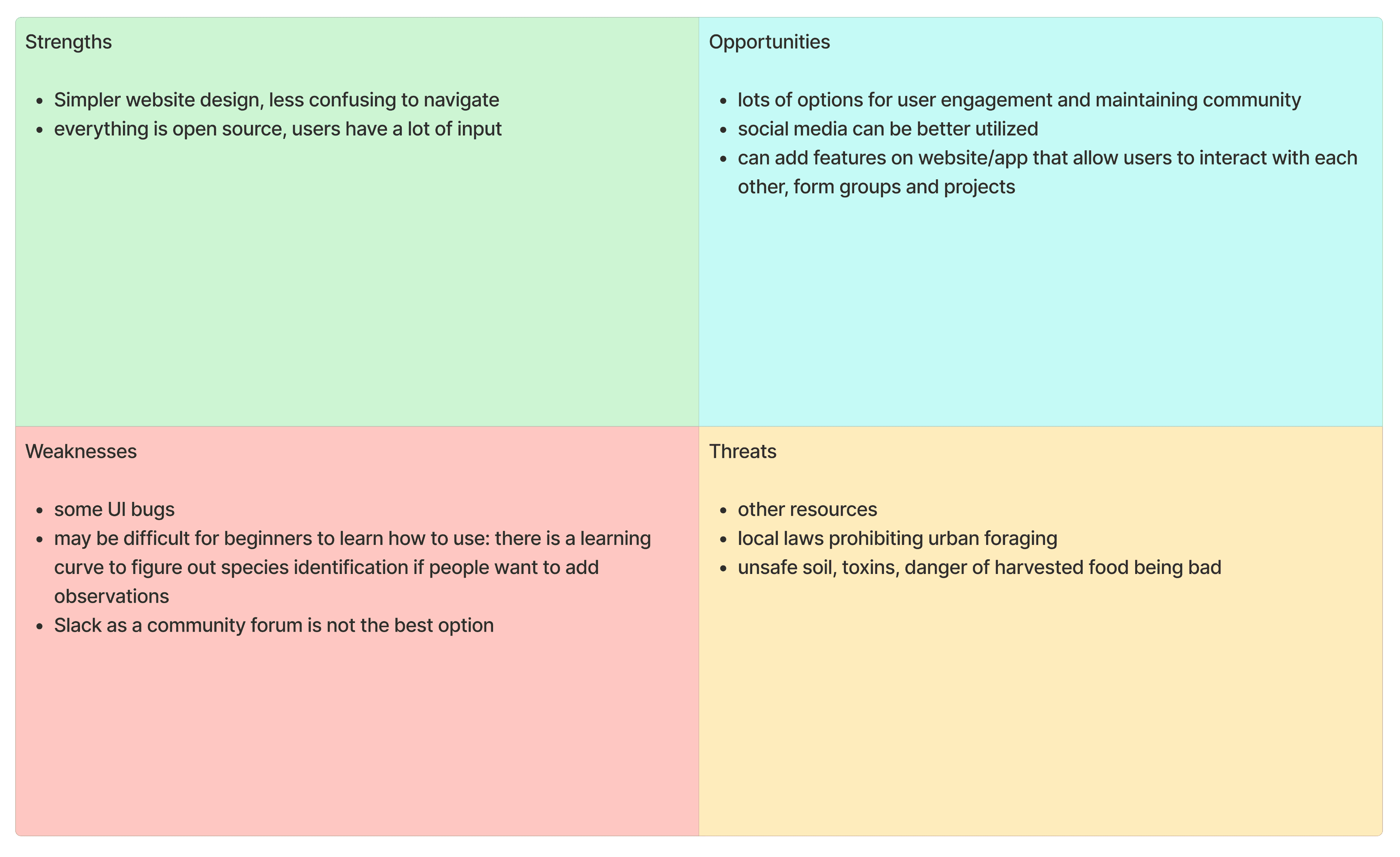
SWOT Analysis & Survey Data
User Survey Summary
Once distributed, the survey received over 100 responses within the first 6 hours and 235 total. To maintain consistency and manageability, we capped our dataset at 150 responses for analysis.
Data cleaning was done in GitHub using Python. This included filtering out incomplete or irrelevant entries, normalizing categorical variables (e.g., standardizing state names and binary responses), and formatting the dataset for structured analysis to ensure accuracy.
We synthesized our survey data into a report that included user likes and dislikes for the current application, feedback, tools, resources, and platforms used, as well as community activities and general demographics.
Based on the research above, we performed as SWOT analysis of Falling Fruit to identify Falling Fruit's current position and areas of improvement.
However, this was all based on online research and comparison with other resources, so we had little information on actual Falling Fruit users.
Our next step was a survey to get multiple points of view and understand the demographics, interests, and behaviors of Falling Fruit's broad user base. We asked Ethan Welty, the founder of Falling Fruit, if he could send out our survey as an announcement on the Falling Fruit application.
We were the first team to propose a user survey, and after presenting our plan, several other teams expressed interest in conducting their own. To avoid overwhelming our shared audience with multiple surveys, I took the lead in coordinating with other team leads to consolidate all our questions into a single, comprehensive survey divided into clear sections by topic.
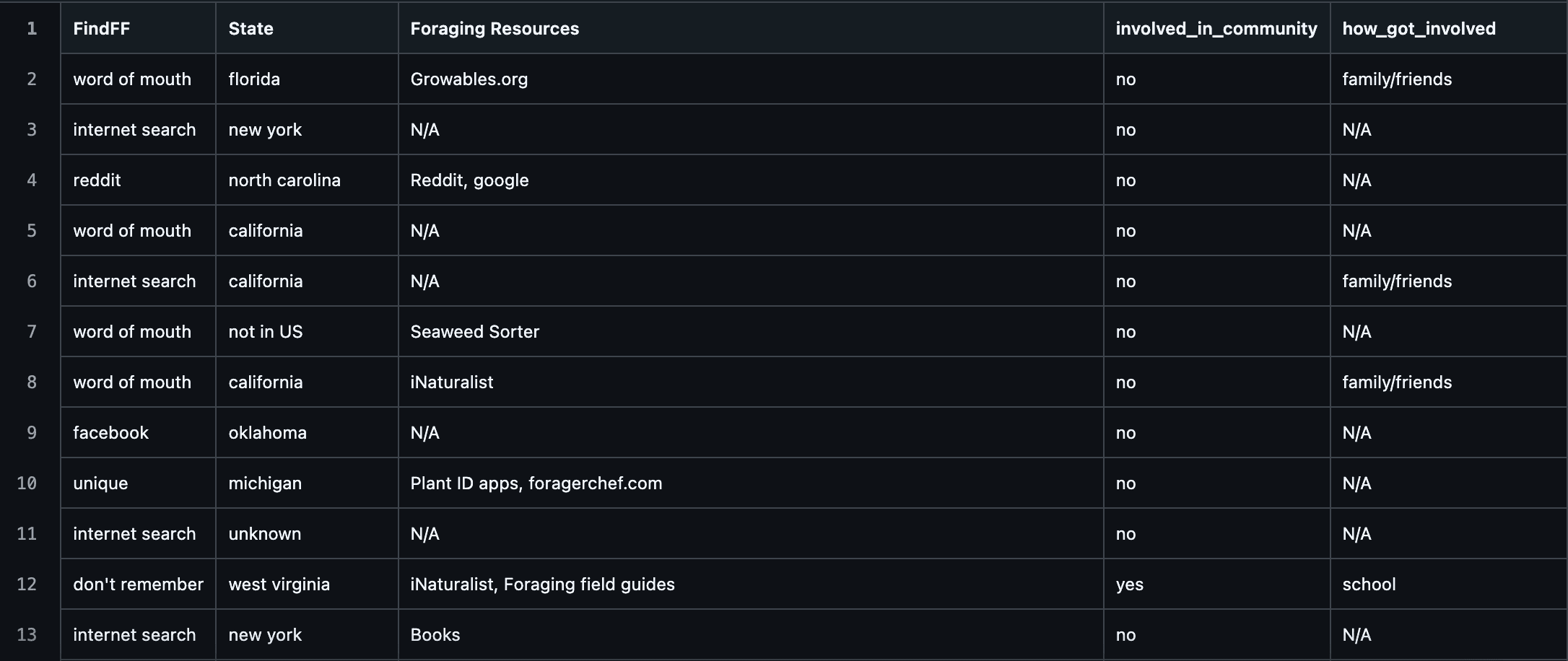
Key Insights:
Users liked the crowdsourced nature, sharing info with others, and the variety of plants and details
Users disliked outdated information, a lack of safety precautions, and not enough local users
Many users wanted a community page or resources to connect with local groups
Only 4% of respondents have been foraging for less than a year, meaning many users have had at least some experience or background knowledge in the field before finding Falling Fruit
63% of respondents were not involved in a foraging community, but many expressed interest in joining one
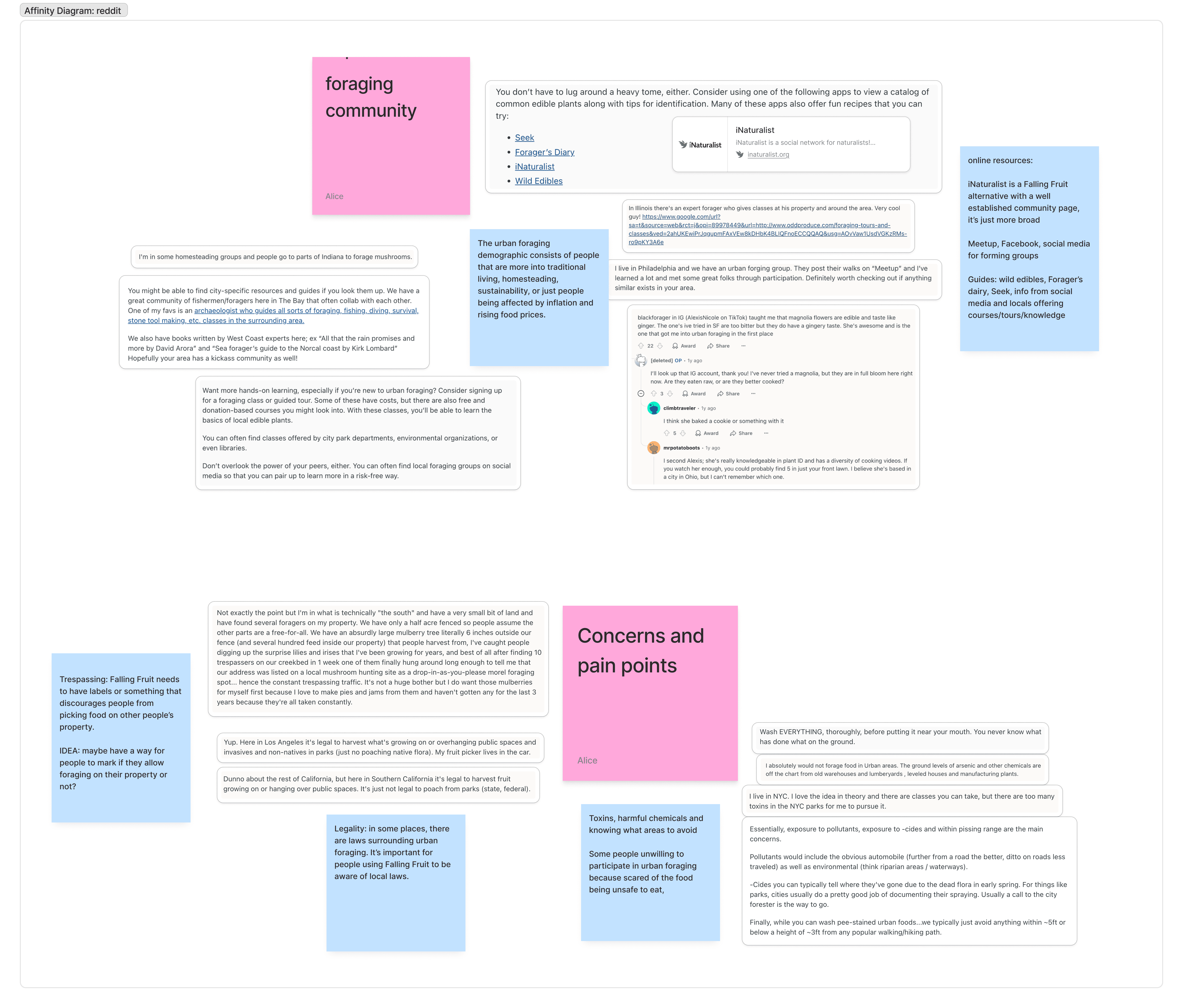
Secondary Research: Reddit Affinity Map
Key Insights:
Foragers are motivated by sustainability, traditional living, homesteading, and rising food costs
Resources they use include guides like iNaturalist and Forager's diary, as well as social media (Facebook, Meetup, etc.) for forming groups
Some foraging pain points include fear of toxins or the harvested food being unsafe, legality issues of whether picking the fruit is allowed, and a dislike towards people who trespass onto others' properties
We began by analyzing r/foraging to understand the urban foraging community’s motivations and pain points. As a highly active forum, it offered quick, authentic insights into user behaviors and community dynamics.
DEFINE
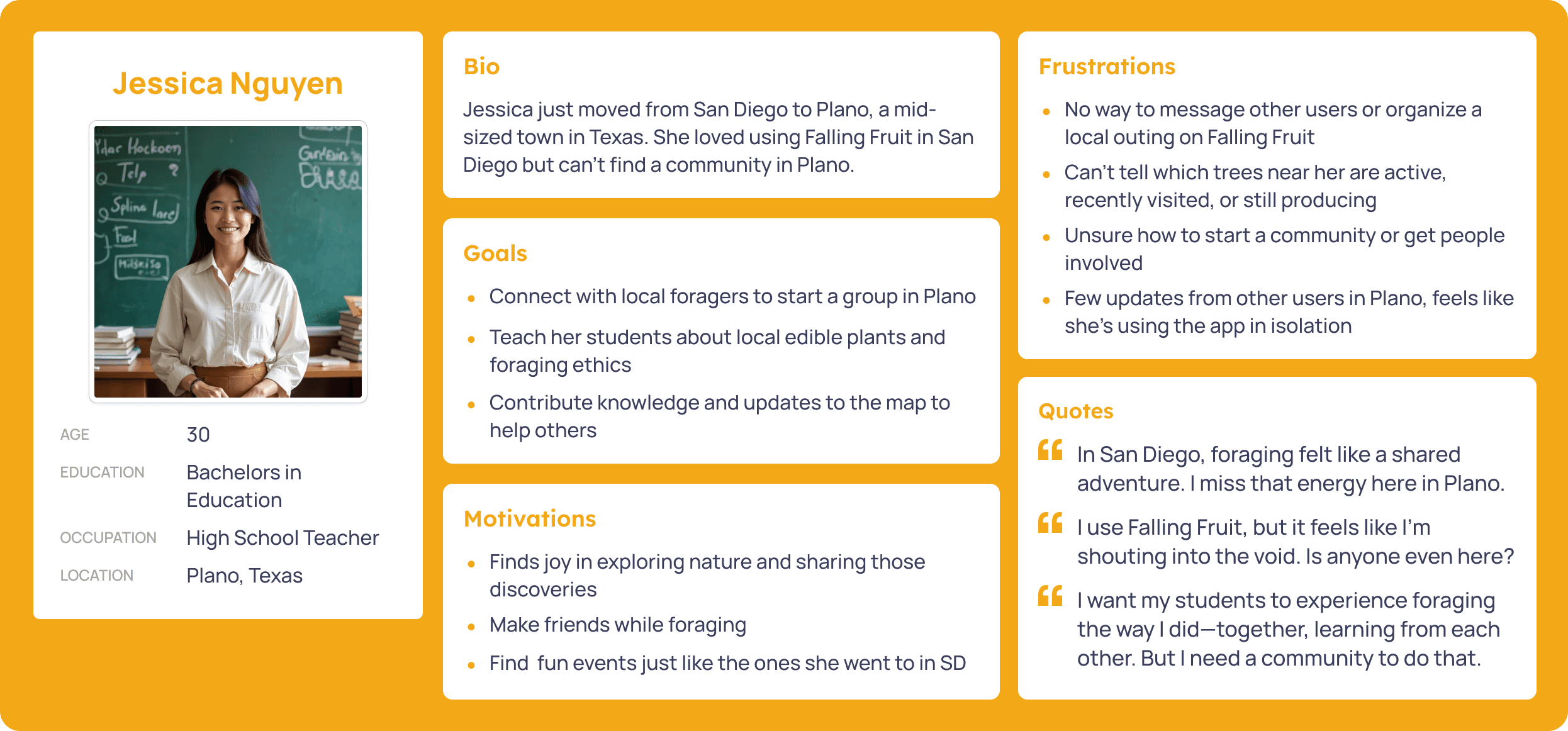
User Personas & Stories (based on User Survey)
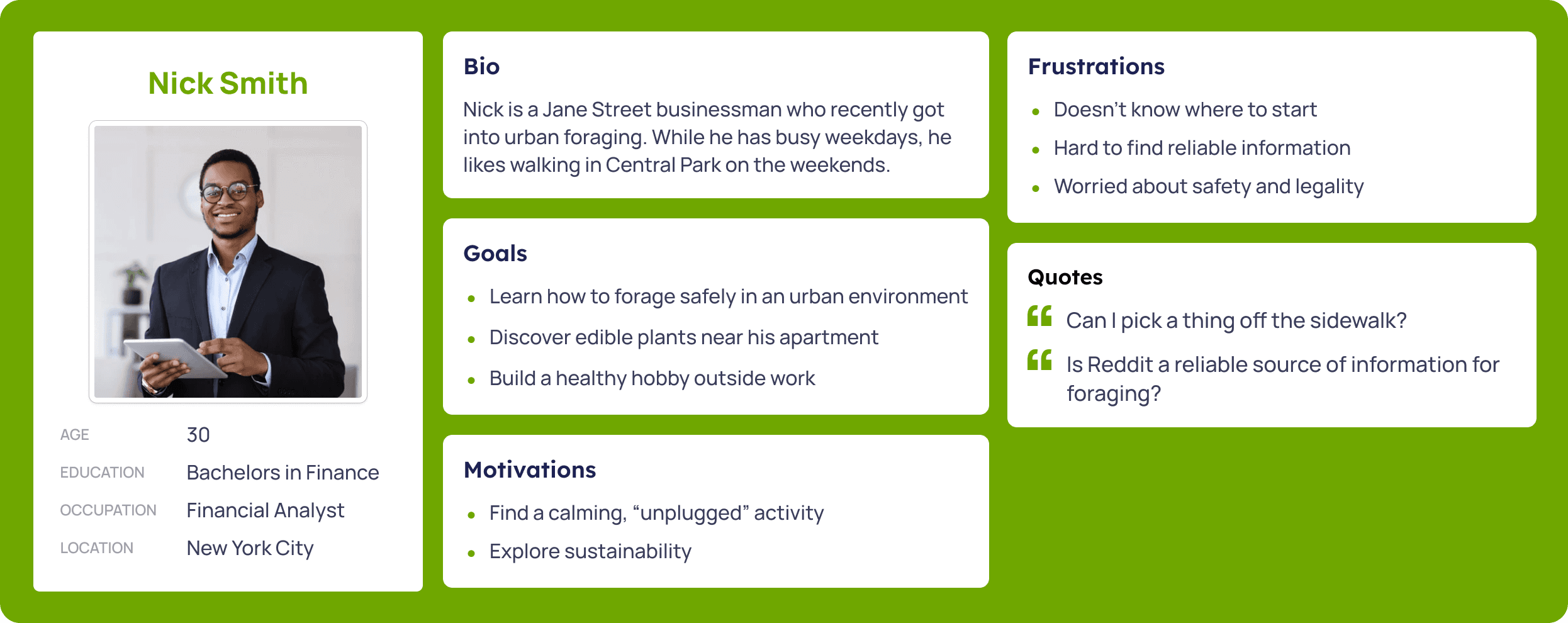
User Story #1
Scene 1: Reads NYT article about urban foraging; sounds like a cool. sustainable hobby that gets me to go out after being stuck inside a cubicle all day at work.
Scene 2: Googles how to forage in NYC and finds blogs and Reddit threads, YouTube videos, and social posts, but they are all over the place and not beginner-friendly
Scene 3: Sees comment mentioning fruit trees in Prospect Park and finds unripe berries. He thinks it might be edible, but he doesn’t want to risk it.
Scene 4: Goes home and feels frustrated; the lack of proper, detailed, and beginner friendly documentation and resources is discouraging.
Survey Quote:
“No community aspect, I’d love to see an ability to communicate or ask for help IDing. … I’d like an educational aspect as well”
User Story #2
Scene 1: Foraging used to be one of her favorite activities; now that she just moved to Plano, she’s excited to see and explore what’s growing nearby.
Scene 2: Opens falling fruit, but there are few listings and no indicators of how active or accurate the entries are. No comments, no photos, and nobody nearby to validate or collaborate with.
Scene 3: She goes out to check a listed location, but the tree is gone and replaced by construction.
Scene 4: She wishes falling fruit would support the effort to update tree entries through forums, event tools, or location based notifications.
Survey Quote:
“Being able to organize foraging outages/events could be huge for the platform despite bringing about its own challenges along the way.”
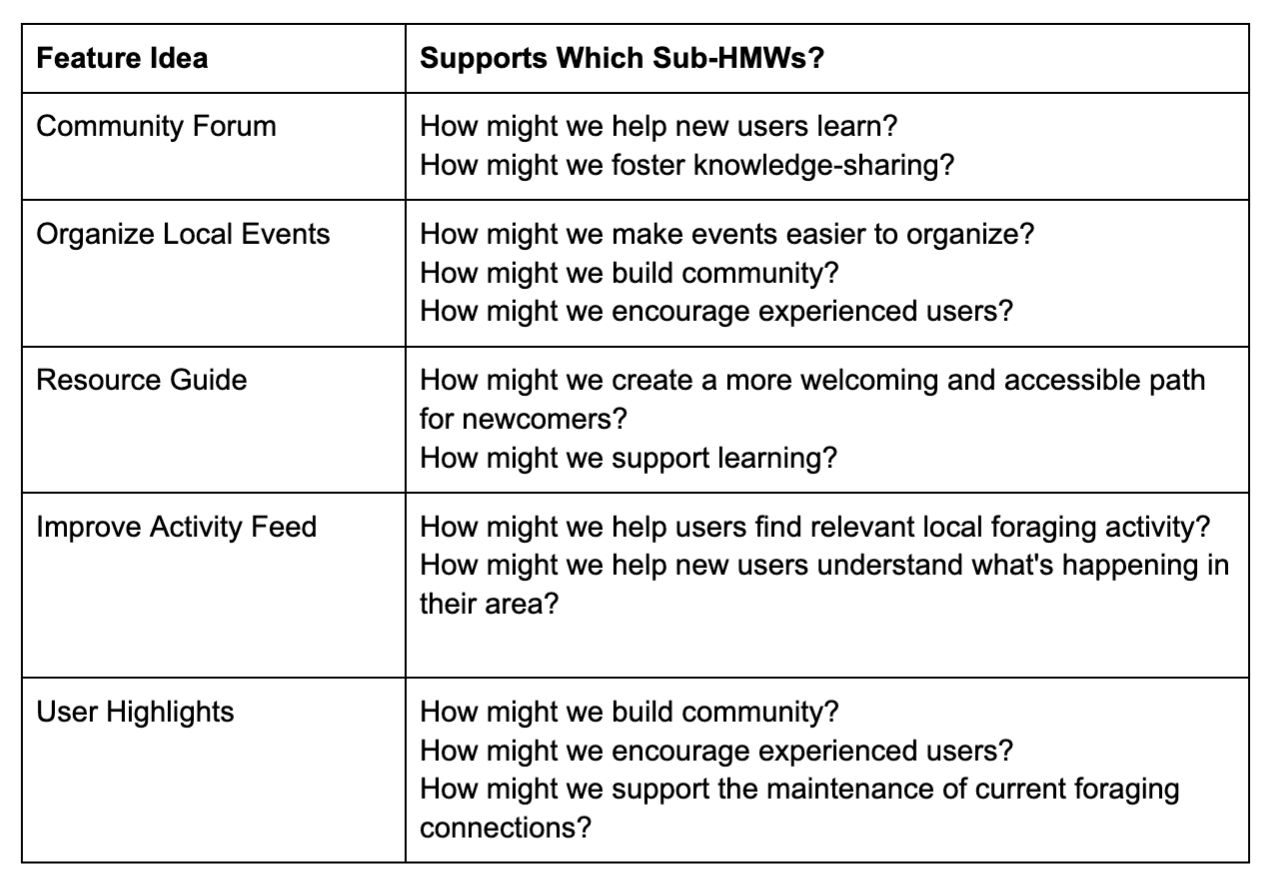
With only a week to build our prototype, we prioritized features that were both feasible and impactful. We chose to focus on a community feature that supports user-to-user connection and knowledge sharing, based on clear needs from our research. While we uncovered other technical issues, we excluded them to stay focused. Insights from our user survey were shared with Ethan Welty and the Falling Fruit team for future improvements.
Concept Selection
How Might We…
Provide the existing foraging community with the tools they need to engage with, educate, and support each other in their foraging journeys?